This review page is supported in part by the sponsors whose ad banners are displayed below |
 |
 |
 |
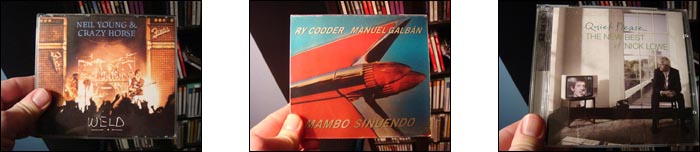
On Quiet Please: The New Best of Nick Lowe [Yep Roc 2619], it was easy to hear Lowe’s clever word play and his catchy hook-laden rhythms in which the notes flowed with the sort of liquidity I normally associate with good valve amps. With the Emitter, the performances on this twofer set spanning thirty years were exciting, colorful, weighty and wildly propulsive. |
|
Tracks such as I Knew the Bride (When She Used to Rock in’ Roll) and Cruel to Be Kind were a gas. However, the Emitter’s transparency and resolution of low-level detail did not hide the flat two-dimensional sound quality or smooth over the hard edges of some of Lowe’s material. But it wasn’t overemphasized either. The Emitter presented a huge, deep, expansive soundstage that was spectacular depending on the recording. The terrific sense of scale and occasion of Sir John Barbirolli’s magnificent and achingly passionate recording of Elgar’s The Dream of Gerontius [EMI 3-91973-2] was overwhelming. The diction of soloists and chorus was clean and intelligible. Individual images, be they instrumental or vocal, were solid without unnatural edge and were surrounded with a beguiling aura of space. It all came across as an organic seamless whole where I could still zero in on the most minute detail. And none of this was at all artificial. If the recorded acoustic was smaller or studio-bound, that’s exactly how it sounded. But throw on any of Telarc’s sonics blockbusters for example and you’d best fasten your seat beat because Kansas will definitely go bye-bye, Dorothy.
Images projected into my room for a good dose of immediacy rather than remain arrayed behind the plane of the loudspeakers. However, the amp’s careful balance prevented this from becoming too aggressive or in my face. The Emitter exhibited a remarkable sense of ease with no signs whatsoever of dynamic compression regardless of volume setting. Speed, clarity and bottomless power were the order of the day.
|
|
|
|
 |
Neil Young’s kick-ass live Weld set [Reprise 7599-26671-2] with its thick raunchy guitar sound, throbbing bass line and thud-like drum kit came across with impressive realism, power and scale. I cranked up Rockin’ in The Free World and Cortez The Killer to ridiculous volume levels and I’ll be damned if there were any signs of compression or strain. The only strain were the relations with family members running for cover.
I should point out that the Emitter’s bottom end was blessedly free of that awful lumbering synthetic droid bass that seems to be the bane of far too many high-power solid-state amps. It was instead taut and tuneful with a good sense of forward momentum.
The ASR Emitter I offered great insight into the minutiae of Ry Cooder’s and Manuel Galbán’s playing techniques on Mambo Sinuendo [Nonesuch 2-7969], their bending of notes, the slides, slurs, percussive effects and all the subtle dynamic inflections. The Emitter was also quieter, darker and deeper between the notes than pretty much anything I’ve heard before. |
|
Claus Peter Flor’s sumptuous recording of Suk’s Asrael Symphony [BIS SACD-1776] was intensely impressive right from the start with the great orchestral tuttis reproduced superbly. The Emitter’s way with this disc was consistently moving while never sounding strained or harsh. The creepy Andante was suitably surreal and eerie while the Adagio, a glowingly intense portrait of Suk’s late wife, was heart wrenching yet also transcendent as it should.
|
While wildly impressive in many areas, the ASR Emitter I did not quite draw me into the music to the same degree as the similarly priced Audiomat Opéra Référence. Whatever the latter’s comparative sonic shortcomings, it was easier to enter that trance-like state between consciousness and unconsciousness where time and space seem to bleed away.
With the ASR, I had to work at it a little harder. While I raved about how the Emitter handled the Elgar disc, the hairs on the back of my neck did not stand on end as they do consistently with the Audiomat. Nor did I quite connect to Gerontius’s anguish, fear, hope and final rapture. This surprised me. The Emitter was clearly the technically superior sounding amp. It had it all - transparency, spatial resolution and dynamics up the wazoo - and more so than the Audiomat. It certainly gave me the what of the music while the Audiomat better communicated the why. I have no technical explanation for this other than that it was strictly an emotional response on my part.
|
|
|
|
|
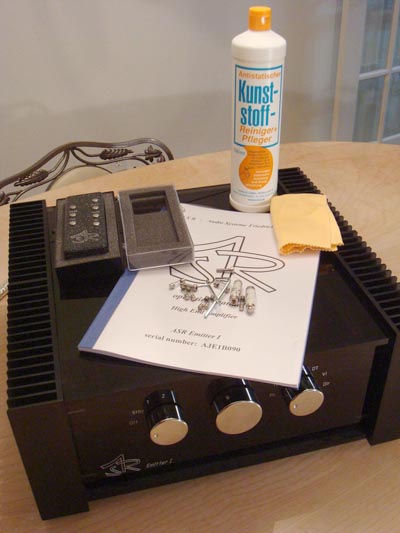
Having said that and putting aside personal listening biases, I recognize that this remarkable sounding and magnificently appointed amp is one of the finest I have ever heard and laid eyes on. It is therefore truly worthy of our Blue Moon Award. If you are wired differently than I and have ten grand burning a hole in your wallet, this could be your dream amp. I strongly recommend wrapping your ears around one if you are looking at amplification in this price range. Even if you cannot afford it, the ASR Emitter I will give you a glimpse of what’s possible. And I’ll wager that it seriously challenges more than a few separates at its price and perhaps higher. I can only imagine what wonders the upscale Emitters might offer...
|
|
 |
Quality of packing: Excellent.
Reusability of packing: Appears reusable several times.
Quality of owner's manual: One of the most comprehensive manuals I have seen yet. However, English translation was fair at best. Some concepts were confusing.
Condition of component received: Flawless.
Completeness of delivery: Perfect.
Website comments: Excellent. Plenty of info and excellent pix.
Human interactions: Professional and friendly. Musical Sounds is one of the more pleasant and responsive distributors I’ve dealt with to date.
Pricing: Expensive for sure but considering what you get both physically and sonically, the price seems perfectly reasonable.
Final comments & suggestions: Rewrite portions of the English manual, otherwise don’t change a thing. |
|
|
 |
 |
|