This review page is supported in part by the sponsors whose ad banners are displayed below |
 |
To do so meant a lift. When we took possession of the house a few months ago, our Avantgarde horns too were transported upstairs by a lift the movers brought along. They did a fine job handling our precious cargo with love and care. Commissioning them again for the move of the Pnoe was thus a foregone conclusion.
|
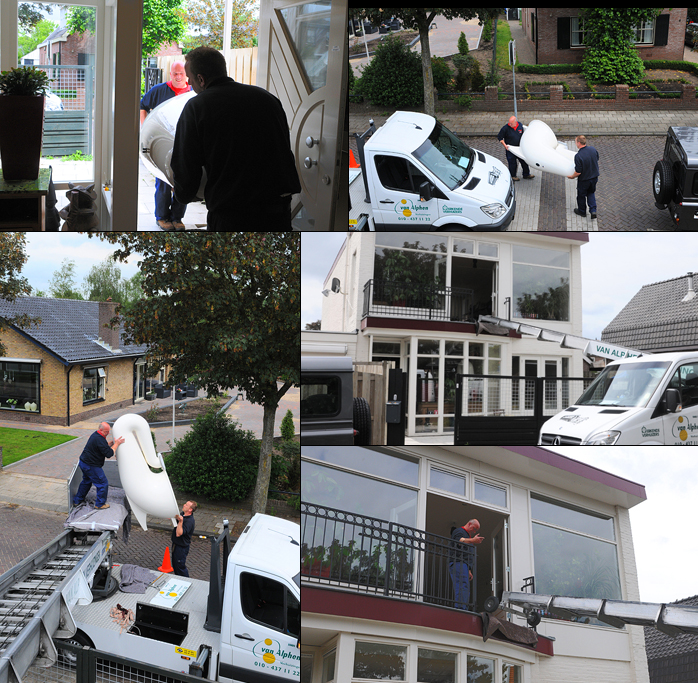 |
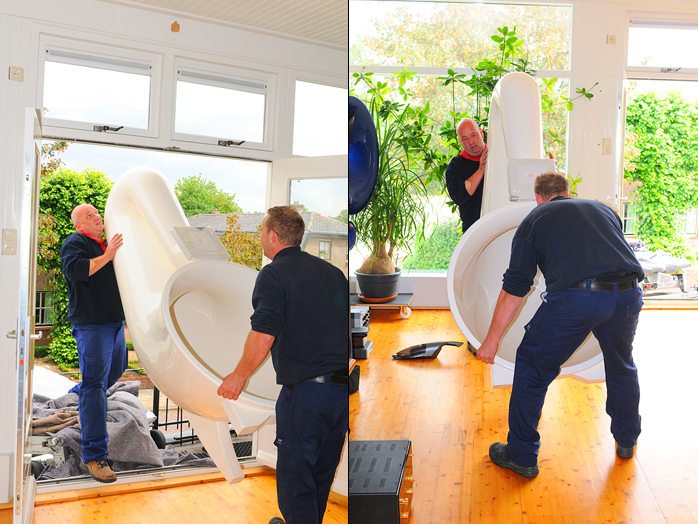
To get the big horns inside, a part of the balcony railing had to be removed. The movers’ lift did not start at ground level so the speakers had to first be hoisted into the lift’s platform. It took two strong men quite some effort to get 52 kilos of smooth and very slippery horn on the platform. Once secured, the lift at its slowest pace brought the horns up one by one moving to our 1st-floor listening space.
|
 |
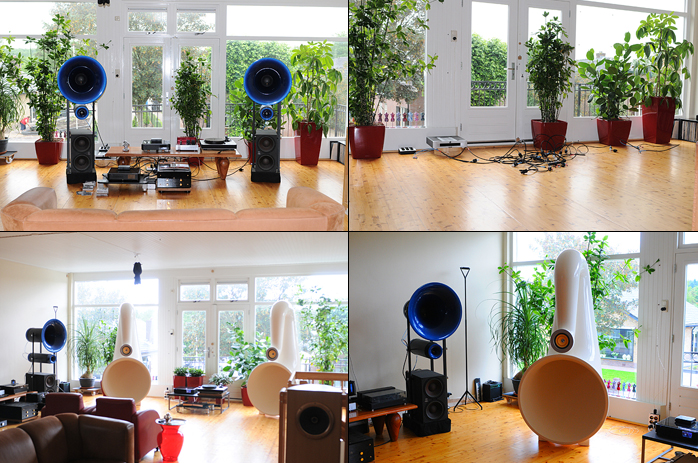
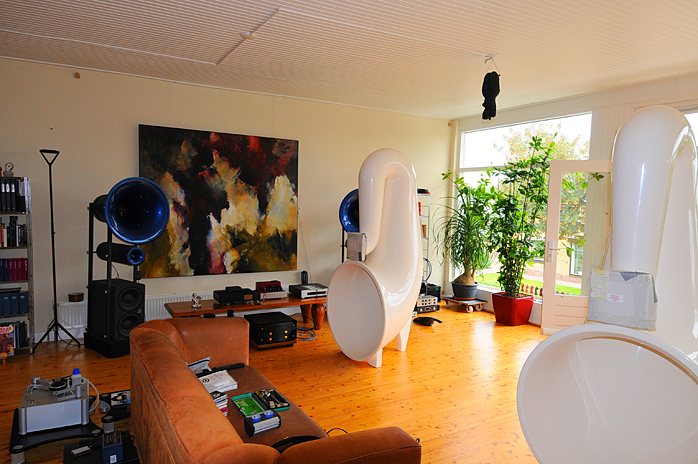
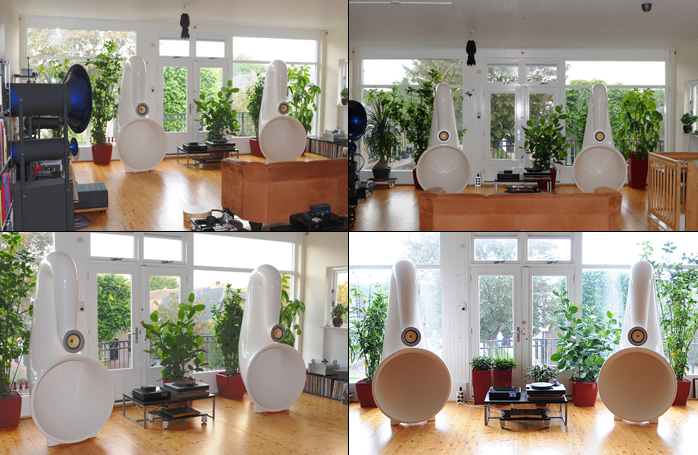
Welcoming a second pair of big speakers here meant rearranging the room. The Avantgarde setup had to move to the sidewall so the Pnoe could occupy the prime spot in the sun. After some shifting of furniture, we now actually have two active setups at 90° from each other. We only have to turn the listening chairs to one or the other and take off.
|
|
|
Here the Pnoe set now comprised a PS Audio PWT for digital and Feickert Blackbird with Zu DL-103 Grade II as analog source for a Devialet D-Premier running V5.3 software on a complete Crystal Cable loom. For the Avantgarde a PS Audio PWT/PWD and custom Thorens TD160 with Trio TRV EQ3SE phonostage are the sources for our Audio Note Meishu. Here all cables are ASI LiveLine.
|
 |
The Pnoe now was in an acoustically familiar environ where living with our other horns had already helped us tame the echoic aspects. Their bed was made as it were. The upstairs listening room is more lively than the room downstairs where a Rockfon suspended ceiling attributes to a short reverberation time. Initially the two horns were 3.5 meters apart which converts to a listening seat distance of 4.26 meters using the rule of 82%. Regarding toe in, we began with just a few degrees.
|
 |
Measuring the setup is one thing, listening to it is the real deal. Out came our current favorite recording, Nama by Puente Celeste, a 24/176.4 M.A Recording that found its way into the PWT transport. What we now heard was not exactly as expected. Mid and low frequencies were fine but the upper range was somewhat attenuated. The sound was like a glass of almost flat champagne. Most of the taste is there but it lacks the telltale fizz. Downstairs we did not lack any liveliness. A little more toe in now helped but that only served the sweet spot, not the rest of the room. Before the Pnoe took their stand, the Avantgarde Duo had occupied the same spot. Behind them, 17 ASI sugar cubes were installed on the large glass panes and dialled such that the Duo would never be too bright. With the less ‘in your face’ character of the Pnoe, the cubes could and needed to be turned back a little to open up the sound. Thirty seconds later, the sparkle was back as expected and we were very pleased with the sound, image and tranquility. With different speaker characteristics, room tuning needs some adaptation here and there.
|
|
|
Over the next few days some minor toe-in adjustments and slight twists of one or more sugar cubes perfected the setup. We heard quite some people state in no uncertain terms that a round horn with a single driver must be limited in the frequency extremes. A rolled-off top debits air and detail while the size of the horn’s mouth limits the bass. As we witnessed, Arcadian Audio made a very clever choice in the AER MD3B driver which begins life as a true widebander. Once augmented by the expanding folded Pnoe horn and smooth surface treatment, the driver truly excels itself.
|
 |
Bass was never boomy or boxy. It remained organic always and reached without fuss to the 40Hz of an upright’s open E string - and the player could pop that string with gusto. In the ever important midrange voices lived sweet and articulated. Higher up where instrumental extremes reign together with vital overtones and transient energies, the rendition was controlled and free of peaks and other nasties. Power handling was excellent. With plenty of volts available from the class A-D hybrid amplifier, we could fill our 400 cubic meters without any sweat to very high levels. Our ears would cave in much before the loudspeakers.
Sometimes our house is like a thieves’ den when equipment to be reviewed gets picked up or delivered. In some cases the designer, manufacturer or dealer is allowed to enter, on rare occasions some may even stay for a listen. We burned our butts one time too many and now keep to a very strict door policy on who may enter and who may not. |
  |
|