This review page is supported in part by the sponsors whose ad banners are displayed below |
 |
 |
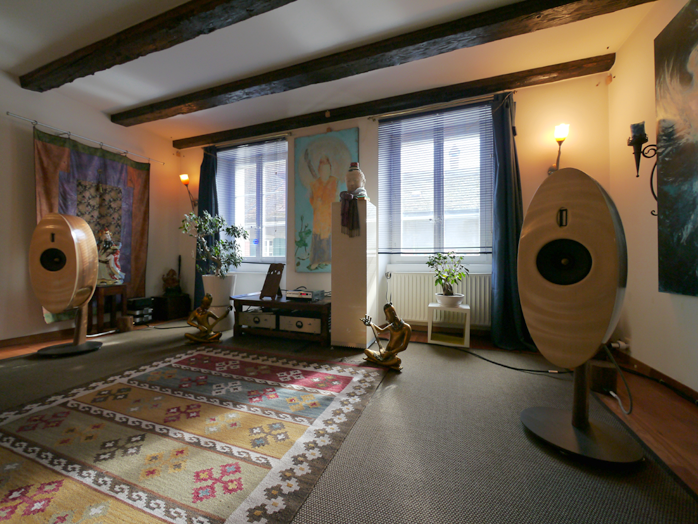
But first my soundkaos Wave 40. Those were up already.
At ~93dB they're of low sensitivity for a widebander but higher than most standard dynamics. It means that for 70dB average levels with 90dB peaks—I usually average mid 60s with peaks below 80dB—I consume 1/10th Wrms and max out with 1-watt climaxes. Whilst easy peasy on paper, some amps want to shift up a gear or two before full torque kicks in. This combo suggested such reasoning to explain why it seemed a bit dull and anaemic. Of course my usual stuff is a €3'000 DAC with €1'000 USB bridge plus €12'000 preamp. For the benefit of the doubt I connected the usual front-end to replace the Aura Note's internal converter. Whilst better this didn't overcome the inherent sense of energetic reluctance and dimensional restraint. Clearly my Swiss tonewood ovals preferred the speedier wide-bandwidth reflexes of a Crayon CFA-1.2, Bakoon AMP-12R, DC-coupled Goldmund/Job 225 or single-stage single-ended FirstWatt SIT1. That's how it goes with all things for all seasons. Sooner or later one does chance upon an exception. No shame in that.
|
 |
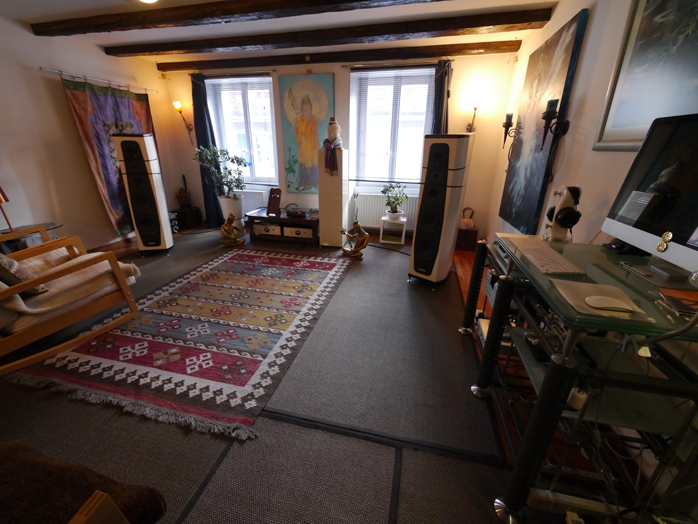
Swapping out speakers for the 5-driver twin-port three-way AudioSolutions Rhapsody 200 rectified it pronto. With a bass balance which innately borders on the beaucoup and requires port plugs unless an amp exerts firm damping, V2's woofer control was spot on. No boominator routine sans plugs. And the gestalt change over the eggs was quite dramatic. This was the type load ICEpower saluted to properly. No tarting up with snazzier source separates was required to hear that.
|
|
|
Over the white Lithuanians I now also confirmed prior desktop assessments. Deliberately as we learnt from Simon's brief, this is not a modern detail-über-alles sound. My Bakoon/Crayon/Job options all veer deeper into that camp. Hence it's also not about the 'space is the place' shingle that shines heightened illumination at it to maximize walk-in transparency. This sound is chunkier, massier, heavier and thicker. Though this grouping of qualities often includes 'dark', here that doesn't apply. We're simply back to the bottom-up observation which starts in the bass to create anchoring and scale. There's light on top but the elements of weight dominate.
|
 |
Amongst other things this invites higher SPL. There's no tendency to get top heavy, shrill or irritating. It's no prima donna proposition that's fun if demanding for a short ride but uncomfortable over a longer haul As owners of true subwoofers know, infrasonics enlarge scale. It's related to the old chestnut that big speakers make big sound, small speakers small sound. So-called super monitors with small long-throw woofers allied to cleverly tuned ports can go astonishingly low all things considered. They can also stage like bandits. Yet for all their Houdini-esque acrobatics leaving behind only wide open space—which is surely big in its own way—their sound lacks that locomotive sense of big. It's stretched out across a broad canvas alright but not put together of the same substance. If sound could be counted by the amount of atoms it involves, the V2 would show a high number.
|
 |
A parallel observation relates to transient sharpness. Air-dominant top-down sound peels out its attacks. This lays bare their edges for more blister, glint and a show of obvious speed. The Aura Note envelops rapidly plucked strings in what surrounds them. This tones down their blister. To borrow another automotive image, think of softer shocks. They don't convey every bump on the road. Subjectively we often relate to such sound as more relaxed. It feels less on edge or forward and more back in the seat. Whilst the V2 is a physically compact small amp, add big speakers and the result is a decidely big sound. That's the key difference to the Premier predecessor my wife listens to. Into the same speakers it's lighter. |
|
|
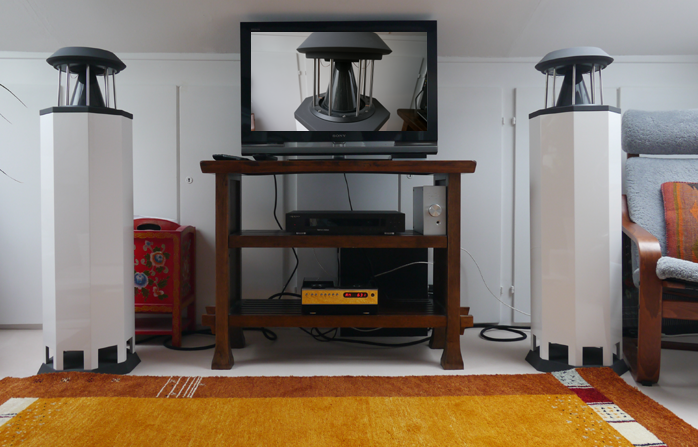 |
That weight, low-down grunt and proper treble life may coexist was reinforced by running the Aura Note into the upstairs 360°-dispersion German Physik HRS-120. With their ambient-dominant not direct sound, the Pascal-based Gato Audio DIA-250 tends to get too dark. It's insufficiently teased out. And that clearly impacts speed intelligibility during movies. The V2's voicing above the upper midband showed more elucidation and finesse to match our true omnis far better.
|
|
|
Updating a good thing with more power that's clearly stable into low Ω; and with more useful features that leave alone everything that was already great—form factor, finish, price—arrives at a predictably happy conclusion. For many people who appreciate intelligent integration and mean to do more with less in current smart-phone style, the latest Aura Note could be the machine they've dreamt of or hoped someone would make. Dream no more. Wake up! |
 |
 |
 |
|
 |