This review page is supported in part by the sponsors whose ad banners are displayed below |
 |
 |
Driving Miss Maybe? Geoffrey Armstrong of Monaco's Sound Galleries copied me. "Just unpacked and set up my Platinum. Encountered same problem. Looks like both of us dutifully installed your Mac driver but could only get max 192kHz and DSD64. Uninstalled it and instant 384kHz/DSD128 happiness. Tested PCM/DSD. Both play fine. Looks like your OSX driver isn't needed and only cripples the DAC's capabilities." Antelope explained. Whilst 384kHz was indeed there without driver, DSD256 upsampling and stability and player compatibility needed it.
Geoff had a request too. For PCM he fancies iZotope upsampling in Audirvana. He'd like to see discrete upsampler options for PCM and DSD where mixed playlists would have PCM upsampled on his Mac, DSD in the Platinum. Excellent idea!
Geoff also found that a DSD from an old analogue Kleiber recording of Beethoven Symphonies transformed with applied DSD256 upsampling yet wasn't surprised that my designer DSD tracks distributed for demo purposes did not. So that I too might experience a best-case scenario for DSD upsampling he offered to post a few 'dirty' SACD tracks he'd ripped from physical discs with a Sony Playstation 3.
|
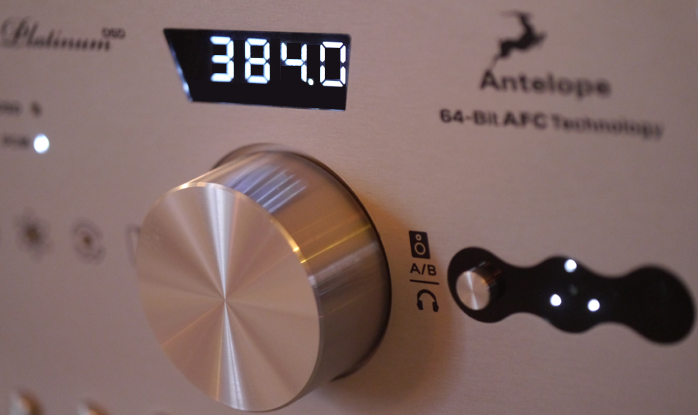 |
Avisha Cohen 96kHz file upsampled to 384kHz in PureMusic which the Platinum thus received at 384kHz.
|
 |
Whilst waiting for those I uninstalled the v2.05 Mac driver. Like Geoff I had instant playback of native DXD 352.8Hz and DSD128 files. Upsampling to DSD256 had worked already. For us the Mac driver seemed redundant indeed. Which was normal. OSX tends to not require any aftermarket USB drivers. Unlike the current DSD hype from certain quarters, I do not hear such files as inherently superior. In fact to these ears many well-done PCM files sound more lively and sparkly. DSD in my thus limited overview tends to sound softer and sweeter but not as refined in the treble. Plus it's somehow colored - admittedly pleasantly so but colored. Lastly the music I pursue remains 99.99% PCM. The Platinum prepares folks like me for the 0.01% eventuality: the rare recordings we want that exist only in this format. Is DSD justified on any real performance advantage? Here my jury is still out too. |
|
|
|
|
|
| Preamp redundancy? After my fling direct and leaving the Crayon in place, I reinserted the Nagra Jazz. Contrast by subtraction had netted more immediacy aka "quicksilvery suchness". Having lived with that for a few days, how would contrast by addition telegraph? As deeper more burnished colors and greater overall gravitas. Particularly on tracks with little rhythmic distraction and sparse instrumentation, this moved attention on tone bodies as presenting themselves a bit as though they'd just hustled around the block at a brisk clip: skin flushed with blood and sweat slick, the whole persona surrounded by a certain aura of vitality or physical vibrancy. Prolonged prior ownership of various valve amps had me certain. I'd run those Platinum direct. That would be ideal to stay the middle between energetic directness/transient speed vs. material substance/color intensity. |
|
|
|
 |
|
 |
In my solid-state context I could go direct and be perfectly content. But in the end I had to admit it. With small-signal valves of Nagra execution in the path I was happier still. That this came at very considerable cost was beyond dispute too. To sacrifice maximally little of the direct connection's spark whilst offering something worthwhile in trade to again walk the middle is no child's play at this level. It's serious engineering business and coin. Think Kondo, Shindo or Nagra for valves; Trinity and Tidal for transistors. It's clear then that where tastes and ancillaries neither demand nor desire the enhancements of superior active line-level signal conditioning, the Platinum as a system's nerve center can save far in excess of its own sticker on a dedicated preamp. Then it adds headfi two. It's a complete deal seal. |
|
|
 |
| |
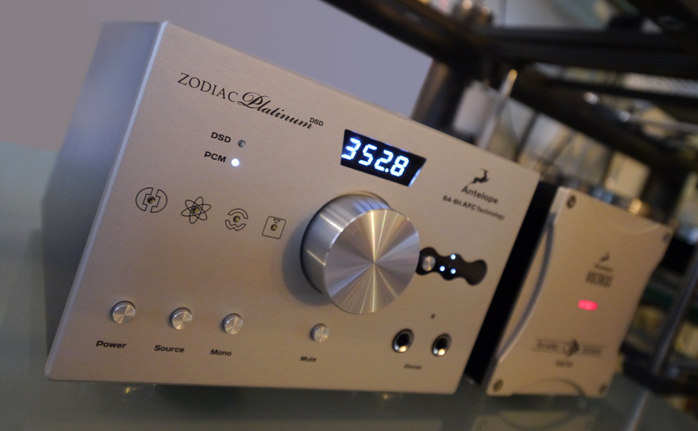
| Final call. Using AURALiC's Vega as useful benchmark—Blue Moon from three of our writers; Red Fingerprint from Polish contributor Wojciech Pacula; AudioStream's Greatest Bits from Michael Lavorgna—Antelope Audio's Zodiac Platinum belongs into the very same club. On sonic excellence it rubs shoulders. It costs $2'000 more but adds a true analog input, two 1/4" ports and click-free analog-precision volume both manually and via remote. If you were to spread that surcharge over a separate preamp and headfi amp, more power cords and interconnects, you'd end up in a lower place. But I did review a similarly featured converter/pre for $2'900, SOtM's sDP-1000. It's such an obvious competitor that shoppers will want to consider it too. In the end these specific DAC/pre options are frustratingly few. Kudos to Igor Levin & team for adding a desirable one with their super attractive slick deck. |
|
|
| Click here for a sidebar on the v2.08 driver and Geoff's tracks. |
|
|
|
|
Quality of packing: Very good, oversized and fully ensconced in high-density foam.
Reusability of packing: Many times.
Ease of unpacking/repacking: A cinch.
Condition of component received: Flawless.
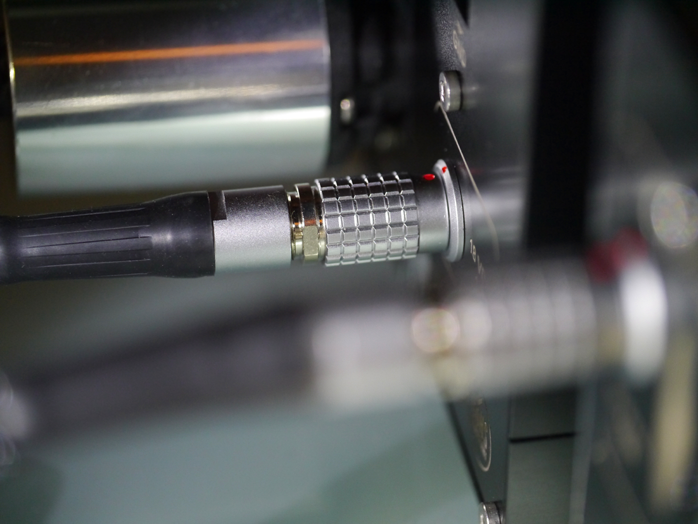
Completeness of delivery: Perfect. Includes USB cable, Toslink cable, power cord, quality locking umbilical for PSU, stylish all-metal remote control with coin battery and owner's manual.
Human interactions: Good.
Pricing: For a shared performance tier higher than AURALiC, Metrum and SOtM but equivalent to Resonessence Labs.
Final comments & suggestions: Unlike on the Zodiac Gold, the XLR/RCA outputs can't be used together. Without 1-to-2 adaptors this negates a subwoofer in direct-drive mode. A future upgrade might consider adding a third mode - just RCA, just XLR and RCA+XLR. The red power LED of the now dedicated Voltikus still matches the Gold's red display but not the Platinum's new bluish white to which it ties. That seems very strange considering the otherwise obvious attention on industrial design. The software panel is a delightfully simple very effective way to access advanced features. It only works though with the deck's own USB input. Using an external USB bridge disables the panel as it can no longer connect to the device it is to control. The synchronous upsampler (all lower 44.1/48kHz rates get upsampled to 352.8/384kHz) can be defeated to turn the Platinum into a quasi NOS DAC; or perform strategic upsampling in player software instead. A future upgrade might consider splitting the upsampling options into PCM and DSD so that mixed playlists can treat each format differently.
|
 |
 |
|
 |