This review page is supported in part by the sponsors whose ad banners are displayed below |
 |
 |
Conclusion. Speakers with widebanders are about as rare as an honest politician. But they do happen. Their roots go back to the very beginnings of audio. Despite the passage of time, the notion of delivering an amplifier signal directly to the voice coil without a crossover and its phase shifts still remains attractive to some designers, music lovers and audiophiles. Since with such a design nothing is suppressed, signal flow is very fast. Here this is further aided by the design of the cone suspension in which energy is not lost as in a classic rubber suspension. The cone itself is ultra-light and sports high 96dB sensitivity. But associated problems are equally numerous. Limited bandwidth (mainly in the bottom as the Acuhorn driver plays the treble surprisingly well and even), limited macrodynamics and low power handling.
|
 |
As usual, it will be our problem and not the designer’s as it is our decision in the end [though a €3.300 speaker with extension barely past 100Hz is arguably also a design problem – Ed]. The Superleggera Giovane85 will help us make such a decision. It is beautifully made. Wojtek Unterschütz is a master when it comes to styling and attention to detail (another domestic person with similar sensibility is Eric Smólski of Eryk S. Concept). He simply has good taste and knows how to apply it to his products. He’s also a music lover which can be heard in all of his speaker and amplifiers. His choices however are so specialized that they may not necessarily coincide with our expectations.
Regardless of our response to its obvious limitations, we should know that the smallest Acuhorn speakers communicate with exceptional ease to bridge the distance of artifice between us and them. They present exceptional microdynamics, very good color in the context of widebanders and should be treated as true works of art by those who are bored with traditional hifi. Considering the possible setups from low-watt tube amps to powerful class D amps with bass compensation, it should be hard getting bored with these. Perhaps it’s finally become possible to create a contemporary version of what people knew 100 years ago?
|
|
|
|
|
Review methodology: My test was an A/B/A comparison with both A and B known. Speaker references were Harbeth M40.1 Domestic stand-mounted macro monitors on Acoustic Revive Custom Series stands PMC GB1i floorstanders; and Dynaudio Confidence C1 Signature standmounts. All were driven by the Soulution 710 power amplifier, Soulution 530 integrated amplifier Leben CS-300 XS [Custom Version] integrated amplifier and Devialet D-Premier AIR integrated. Music samples were 2 minutes long but whole album were also auditioned. The speakers come without spikes or stands so I decided to decouple them from the floor. I used the Acoustic Revive RST-38 anti-vibration platforms and Finite Elemente CeraPuc spacers with ceramic ball.
|
 |
The manufacturer suggests placing the speakers on two wooden slats front and rear like the Japanese do; on anti-vibration platforms; or on spacer pads. I also didn't use my usual speaker cables since these terminals are located deep inside the speakers and their low weight does not allow for thick heavy cables like my Tara Labs Omega Onyx. In such cases I always use the Acoustic Revive SPC-PA solid-core cables. The speakers were positioned 1m from the front wall with bookcases beside them and aimed at my ears with a slight outward slant. They will work best in small spaces and with close seating.
|
|
|
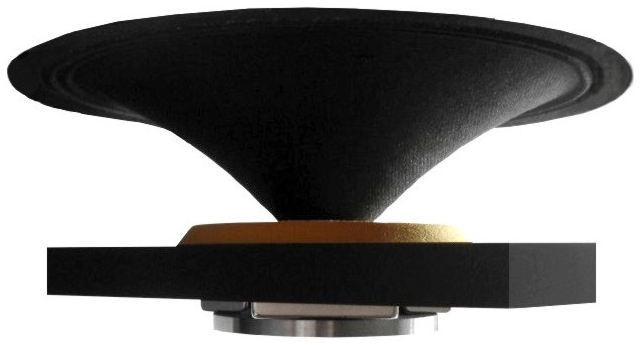
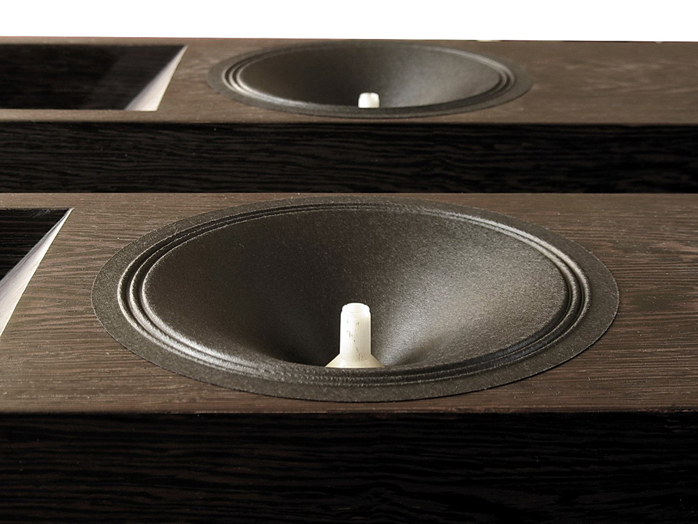
Design. Speakers with a single full-range driver seem to be very simple - one driver, no crossover, just a cabinet and some terminals. The challenges for a proper design and implementation are enormous however. First one must have an appropriate driver. Acuhorn have been experimenting for years with this driver type. Their own proprietary design has a paper cone with fabric suspension, whizzer cone and Neodymium motor. In the models of the Superleggera series the designer went even further. Here the cabinet itself becomes an integral part of the driver. The speaker cone with spider and magnet is glue to the cabinet such that the front suspension integrates directly with the front baffle. The magnet is supported by a solid metal plate. The driver is glued straight into its resonant chamber. There are no screws or basket.
|
|
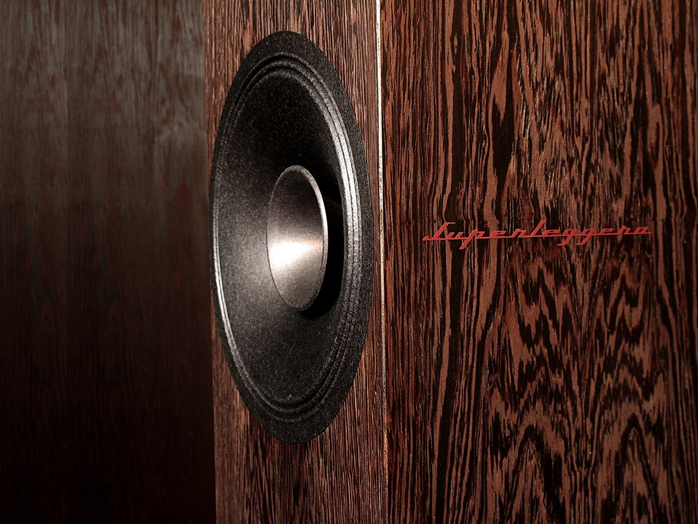
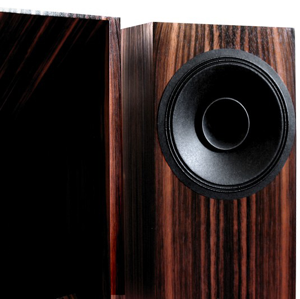
The second problem with widebanders is how to load them. Wojtek Unterschütz prefers horn loading. In bigger speakers that gets easier because we have large internal air volumes and more surface area for a horn mouth. The Giovane85 is tiny by horn standards and looks like a classic box. Hence bass extension is very limited. But because the horn mouth is in the rear, we can adjust the amount of bass to a certain extent with boundary proximity. The cabinet veneers are fantastically book-matched with open-pore coating and everyone in my home liked them a lot. At the bottom of the front baffle silver letters form the company name and a pink Superleggera logo is imprinted on the side wall. Anywhere else it would look embarrassing but here it creates a coherent delicious whole.
Finally the speaker terminals—the least appreciated speaker component—are gold plated and solid like other quality terminals. What’s more important is that they are not mounted to the rear baffle but deep inside the horn mouth. This nearly completely eliminates internal hookup wiring. A peculiar fact is the lack of any spikes, footers or even sockets into which those might screw. The speakers look professional built, are beautiful and will be the pride of any interior. Together with a tube amplifier and turntable but also the Human Audio Libretto HD battery-powered CD player they would make for a system others can only dream of.
|
 |
Specifications according to the manufacturer:
Housing: single chamber tube
Driver: Neodymium broadband Acuhorn Superleggera
Impedance: 8Ω
Sensitivity: 96dB
Weight: 10kg each
Dimensions (W x D x H): 200 x 290 x 850mm
|
|
opinia @ highfidelity.pl |
|
|
Publisher's comment: Given good familiarity with this speaker breed—from ownership of Zu, Rethm and Voxativ models to many reviews of them plus others from 47lab, Arcadian Audio, JohnBlue Audio Art, Ocellia, soundkaos, Supravox and more—I would simply say that Wojciech's question "perhaps it’s finally become possible to create a contemporary version of what people knew 100 years ago?" is many years late. Quite a number of makers have worked on the concept for years if not decades including crafting their own high-efficiency drivers. Even mainstream driver companies like SEAS now offer widebanders. An interesting observation in this context are multi-way widebanders where innate bandwidth limits are overcome with auxiliary tweeters (soundkaos, Zu, Ocellia), auxiliary powered woofers (Rethm), tweeters and woofers (Hørning Hybrid) or optional subwoofers. Zu already has two of the latter in their catalogue. Both soundkaos and Voxativ are working on their own. In short, accepting serious bandwidth limits or in trade extravagantly large rear-hornloaded boxes is no longer necessary if one wants speakers with light-coned wide-bandwidth drivers of high efficiency - Srajan Ebaen
|
 |
 |
|
 |