This review page is supported in part by the sponsors whose ad banners are displayed below |
 |
 |
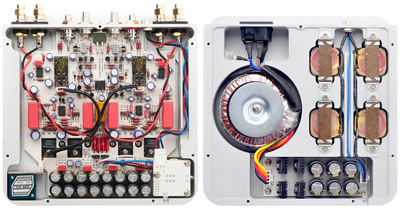
Go Atsah. With their milled-from-billet luxo enclosures making a definitive case for competitor envy—the only exposed screw heads are for the power IEC since the footers conceal the four main belly bolts—shoppers familiar with top Ayre and Jeff Rowland gear might still be surprised. Why were the innards milled out clean rather than isolate each board in its own chamber (particularly the SMPS) as does my €5.000 Bakoon AMP-11R so effectively for its linear power supply? For the substantial $9K tariff*, some could think of this as a missed opportunity. |
|
| |
|
|
 |
* The first press release had Merrill Audio's Ncore Veritas at $6.400/pr. Soon after pricing changed to match the Atsah whilst the Veritas monos gained a downfiring blue LED. Opportunism or consensus?
|
|
|
 |
Shipped with rubber bumpers atop short metal cylinders, one can outfit the Atsah with included spike footers. Now one must pry off their bumpers, remove the M6 bolts with their cylinders and screw in the new footers. Should you want to lift off the bottom plate while all bolts are removed—a paper sticker across the seam indicates that John Young rather not have you take a peek—take care not to shear off the downfiring LED wire. For the spike footers the amps already sport receiver dimples on their tops for stacking.
Also included are Neutrik XLR/RCA adaptors. Because I had my usual 6-meter RCA cable laid out for FirstWatt's SIT1 monos, I tried the adaptors. With three different preamps—Esoteric C-03, ModWright LS-100 and TruLife Audio Athena—this caused ground loops. Only the €24.000 Concert Fidelity CF-080LSX I had on short-term loan from a reader was as quiet on RCA as my equivalent XLR cable was on all the others. While each system is different, there's a fair chance that Atsah plus adapters equals minor hum. The lack of RCA inputs proves that these amps are meant to be driven balanced. So they should be. Then they're absolutely inaudible ear on tweeter. Their high power will scare off the higher efficiency crowd but in this instance that's irrational. Nor must one invoke the first-watt credo which—all too often correctly—implies that über-powerful amps don't come alive at milli-watt levels. These do.
|
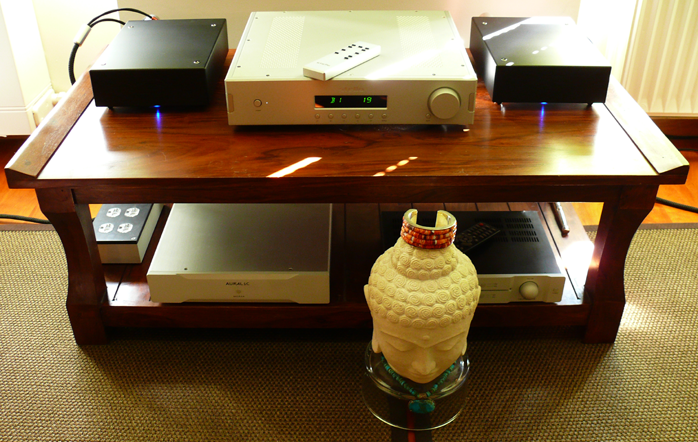 |
What could be a no for true sensitives of the 100dB sort—not that they're at all the target audience—is Ncore's damping. For light-cone widebanders with massive magnets and high self damping, extreme damping factors could cause general overdamping and curtailed bass in particular. Either way you'll want to observe proper power sequencing from the hifi 101 hand book. Having these ultra-potent monos on before your preamp tubes go live could cause nasty turn-on thumps. More than always the rule on power-up is: source + preamp first and second, amps last. For power-down it's the reverse: amps first, then preamp and source.
|
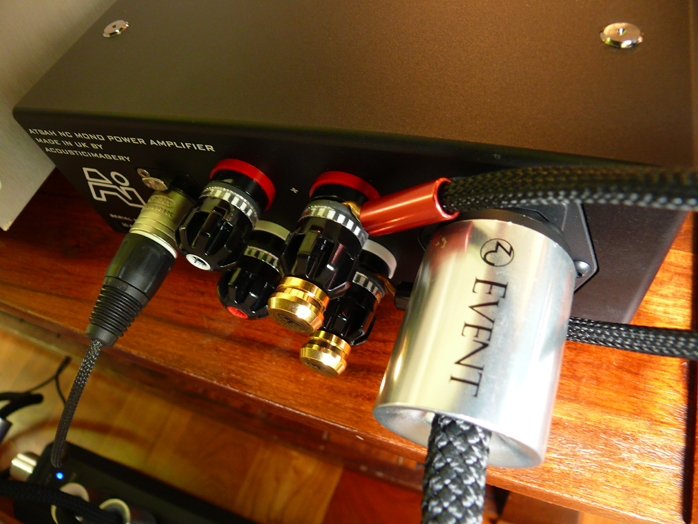 |
On ergonomics. A cord with a fat cylinder like my Zu Event partially blocks the mains switch. Reaching with thick fingers gets a bit cramped. Ideally the power switch would be next to the power LED on the belly as ModWright does it. Or turn the IEC module sideways or upside down if the switch must be on the back. One could leave the amps on indefinitely but not a tube preamp (and I explained already why it could be a bad idea to power your preamp on/off whilst amps are live). Finally the rear panel layout is neither mirror-imaged nor well laid out. With the +/- terminals directly atop each other rather than diagonal or sideways and located between IEC and XLR, spade-terminated cables must enter sideways. This runs them across/around the power cord on the left amp and across/around the interconnect on the right. Perhaps the next chassis run can better sort this.
|
|
|
D-class comparisons. In Lithuania Dutchies eat Danish. The $6.500 Stello Ai700 has its B&O 250ASX2 modules permanently bridged. That outputs 500 watts into 8Ω to compete directly with the Atsah. As an integrated it needed no preamp. I thus ran the matching Eximus DP1 fully balanced DAC with analog-domain volume. For the Ai700, the DAC's pot sat fixed at 3:00 o'clock as its maker recommends. As it turned out, if the converter and speakers are up to the job, going nekkid—sans preamp—won't embarrass the Atsah monos. Rather than pursue the road to anaemic, they blossom. They become more direct, more immediate. In-room presence improves. If desired one could dramatize textures. My ModWright LS-100 6SN7 preamp did though in this particular context I'd not call it an advance but sideways or backward move. It was looser and airier but also more polite, less instantaneous and marginally veiled. 'Energetically distanced' puts it best.
With good recordings at full resolution (16/44.1 and up) I really felt that the sound communicated best DAC direct. This laid off my four preamps.
My sampling between these two class D amps showed how much progress the breed had made. The time has come for the establishment to get afraid. Lack of fear won't signify courage but mere ignorance.
|
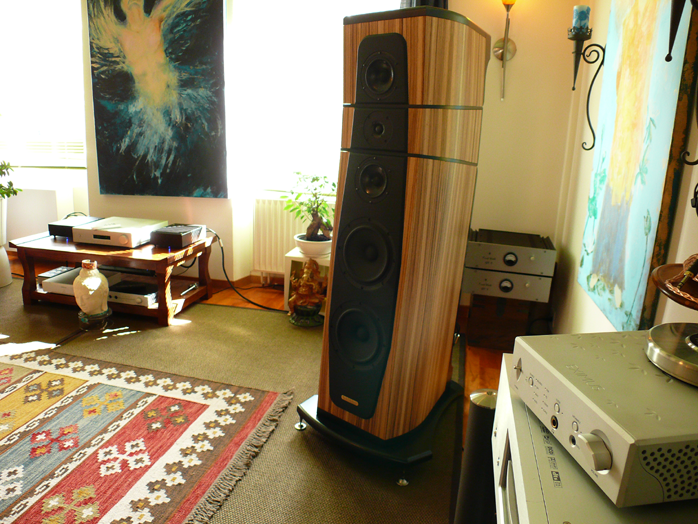 |
On the AudioSolutions Rhapsody 200 speakers from Lithuania, the integrated from Korea was the warmer less lucid operator. It felt built for just a bit more comfort than speed. Push-pull not single-ended if that connects. Here I was surprised by the difference in upper bass. ICEpower was riper and bloomier. Moving to my diagonal writing desk in the room's closer left corner for some verification puts me not only in line with the left speaker. It also parks me deep inside what one would think of as a turbulence zone. Whilst the Ai700 set it off hard to get boomy, the Atsah didn't even activate it. On the 200's deliberately low-Qms dual-port bass alignment which the designer chose for superior dynamics, Ncore's more effective amplifier damping was the needed medicine.
Much of music's vitality and propulsion lives and dies in the 100Hz - 200Hz band called the power region. Overdrawing for emphasis, here the Atsah were Muhammad Ali—float like butterfly, sting like bee—and the Ai700 more of a slugger type. This influenced overall gestalt. To offset what had the Ncores more quicksilvery and transmit more energy or spark of life where the Stello played it darker, earthbound and more muted, I put a different source on the Stello. The Asus Xonar Essence One Muses Edition DAC runs twin BB 1795, an integer/direct-compatible C-Media asynchronous 24/192 USB transceiver, very costly ICs and balanced outs. More angular and incisive than the Eximus, this became the Ai700's minor quickening agent. This successfully narrowed the gap to the Eximus/Atsah set. Fronting the Atsah monos with the Muses Edition of course enlarged it again. But happy component interactions do always figure in final judgment calls.
|
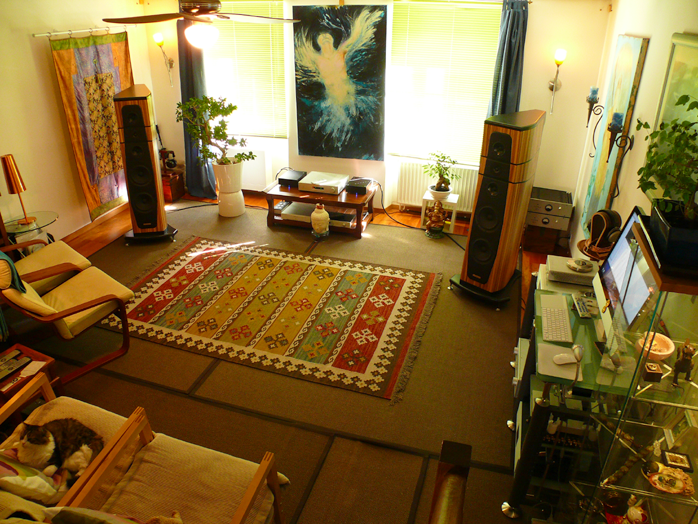 |
On these speakers, this particular combination with the Atsah really leveraged their sculpted in-room intensity which certain writers call lap-dance factor. With that in place I wasn't terribly compelled to relinquish my mostly mono seat behind the writing desk. Blondie the cat could remain in the hot seat a bit longer. Before I was still wishing for more top-end effervescence, air and charge. Drop a sugar cube into champagne and watch those endless trails of bubbly mist. Unexpectedly the converter from Taiwan's IT giant became that sugar cube. Perhaps it was a bit unsettling that these class D amps would get by with such relatively modest source-direct solutions without betraying tonal shortcomings. Yet I had no urge to add my valve-buffered NWO-M or tube preamp for any attempts at color injection. Proper tone density was already in place. Having described these speakers as operating in the legacy Sonus faber mold albeit with a far more American than European bass balance certainly contributed to this conclusion.
|
|
|
Back to B&O and Hypex. Like his Eximus S1 amp, Simon Lee's now beefier class A drivers and ASX2 modules have done away with the entire group of complaints about a bleached mechanical gestalt, zippiness and listener overload from glass-shard detail. Things have became mellower, warmer, denser, more organic and relaxed. They moved from a brightly lit high-noon summer day to a season with more half light and shadows. With the S1 they simply had gone a bit too far into darkness and heaviness. Here the Ai700 had made a small turnabout to advance over the S1. It liquefied some of its stable mate's thickness. It moved back toward the light without sacrificing body gains made already. In this particular process the Ncore amps were simply farther along. They were already deeper into the light without revisiting any ills of the past. What does 'into the light' mean? That having a lucid moment means enjoying a quickened state of sensory wakefulness. Everything is more colorful, intense, alive and real. More on. Some fog has cleared out, some wall come down. In their first round the Atsah monos seemed to play at or near class A SIT1 and class AB AMP-11R niveau with loads more power and superior bass control. I suspected that they might come in second on ultimate treble finesse but a direct A/B would still have to qualify that.
|
 |
|
 |